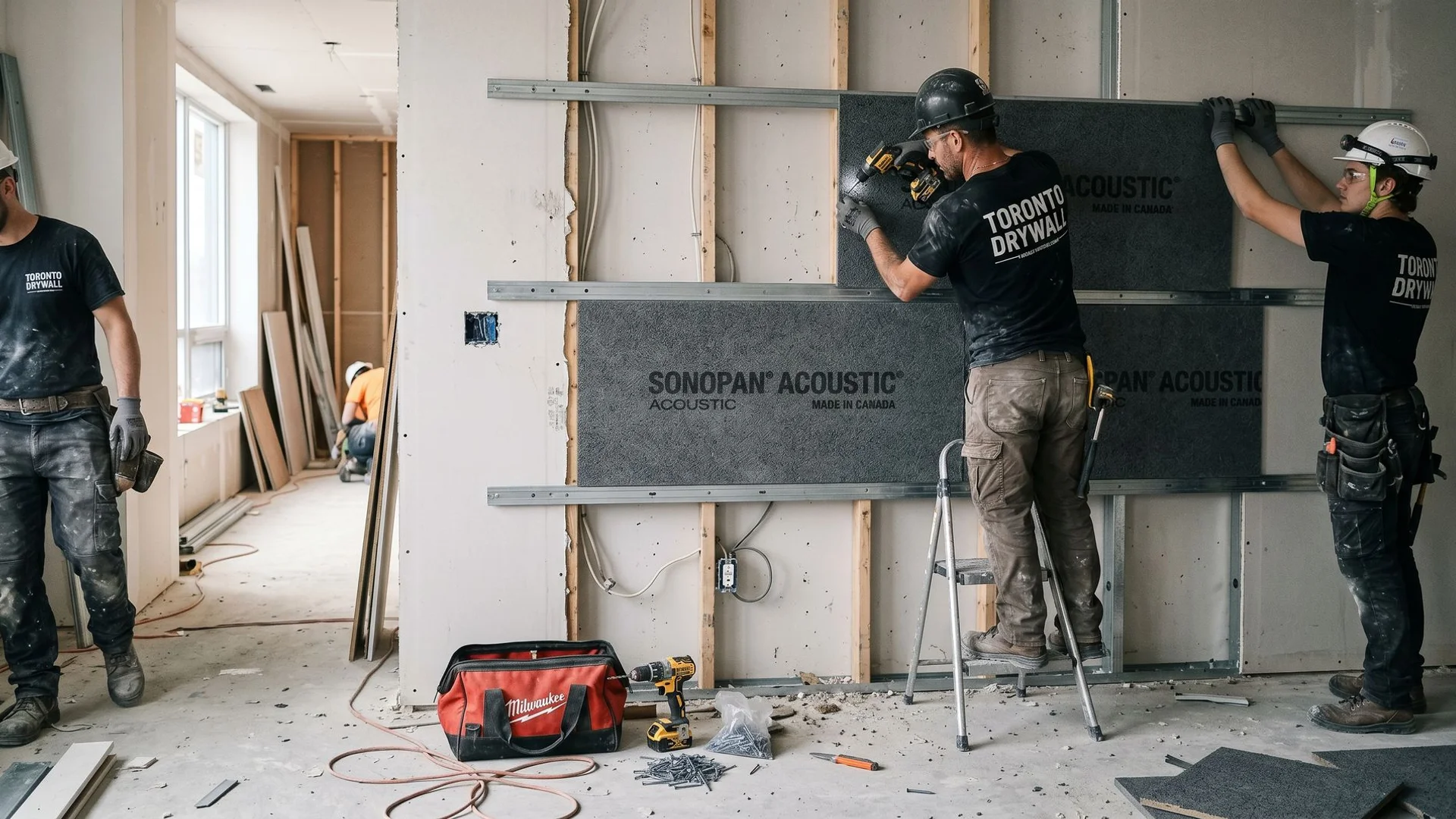
Soundproofing for Toronto Condos, Studios, and Commercial Spaces
Toronto condo living, home recording studios, and shared commercial walls all benefit from a properly engineered soundproof assembly. We install STC-rated systems combining double-layer drywall, decoupling channels, sound-attenuation batts, and acoustic-rated boards like SONOpan and QuietRock.
Most condo retrofits target STC 50 to 60+ on a party wall and 55+ on a ceiling. We’ll walk through what your current assembly likely scores, what each upgrade buys you in decibels, and what stays within Toronto condo board approval rules.
Common Acoustic Drywall Costs in Toronto (2026)
- Retrofit acoustic upgrade (SONOpan plus new drywall layer): $5 to $8 per square foot
- Full tear-out with Resilient Channel and double-layer drywall: $8 to $12 per square foot
- Studio-grade decoupled assembly (STC 65 plus): $10 to $15 per square foot
- SONOpan acoustic panel material cost: Roughly $35 to $50 per 4 by 8 panel
- QuietRock constrained-layer drywall material cost: Roughly $80 to $130 per panel
- Sound Attenuation Batts (mineral wool): Included in most acoustic assembly quotes
- Condo board approval coordination: Included with every condo retrofit quote
A typical 200 square foot condo party wall retrofit lands between $1,000 and $1,600 for a SONOpan-and-new-drywall upgrade, or $1,600 and $2,400 for a full tear-out with Resilient Channel.
How STC Ratings Translate to Real-World Sound
STC 50. Ontario Building Code minimum at party walls. Loud speech is still audible through the wall; normal speech is muffled. Most builder-standard condo walls.
STC 55. Noticeable improvement. Normal speech is no longer intelligible. TV at moderate volume is muffled but still audible.
STC 60. Loud speech rarely audible. TV and music at normal volume are largely blocked. This is what most condo retrofit clients are aiming for.
STC 65 plus. Loud music is muffled. Drums and bass are partially audible but reduced. Studio-grade.
STC 70 plus. Specialty studio and broadcast applications. Decoupled construction, mass-loaded vinyl, multiple drywall layers.
What Each Acoustic Upgrade Does
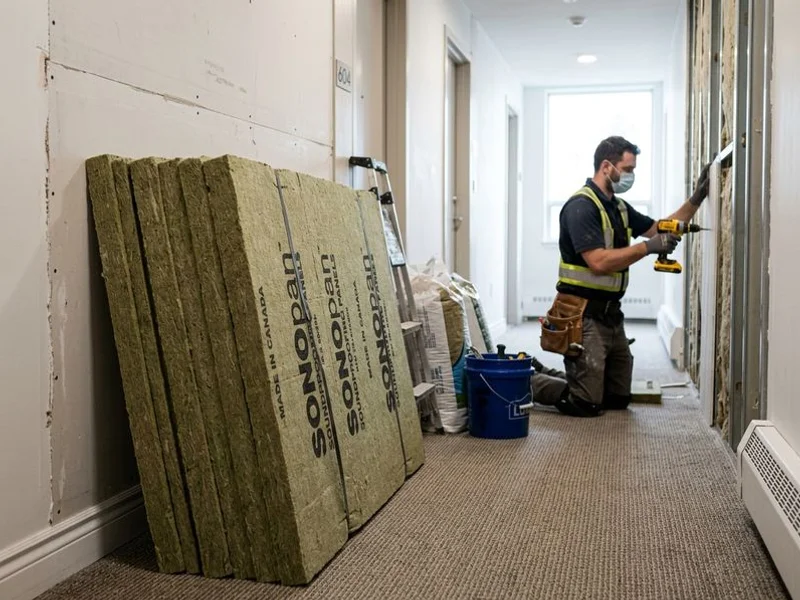
SONOpan. A wood-fiber acoustic panel applied between the existing drywall and a new drywall layer. Adds about 6 to 8 STC points in a typical retrofit. Cost-effective and easy to add in a condo retrofit because you’re not tearing out the existing wall.
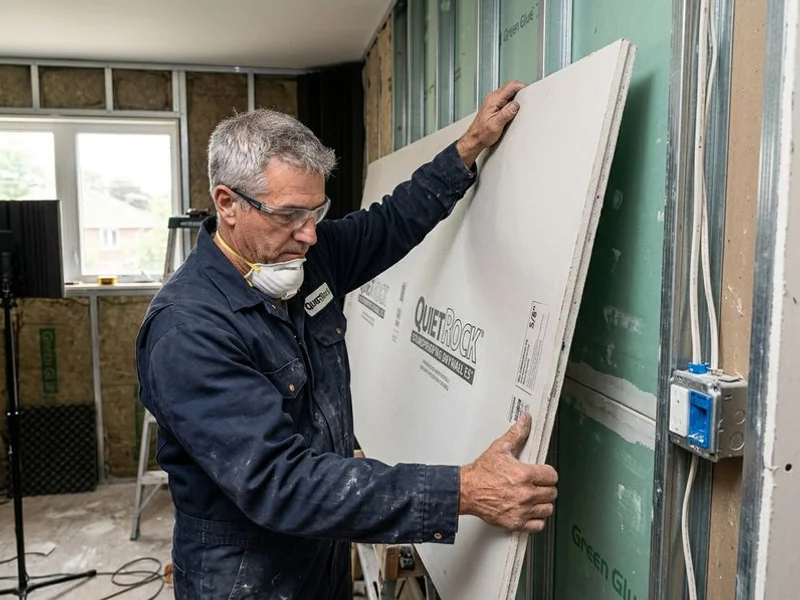
QuietRock. Constrained-layer drywall with internal viscoelastic damping. Replaces a standard drywall layer and adds 8 to 12 STC points compared to standard drywall in the same configuration.
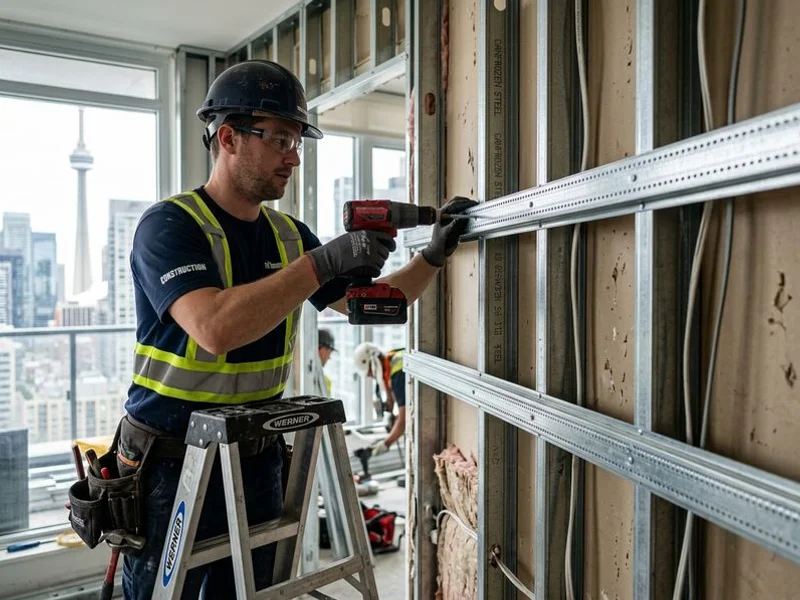
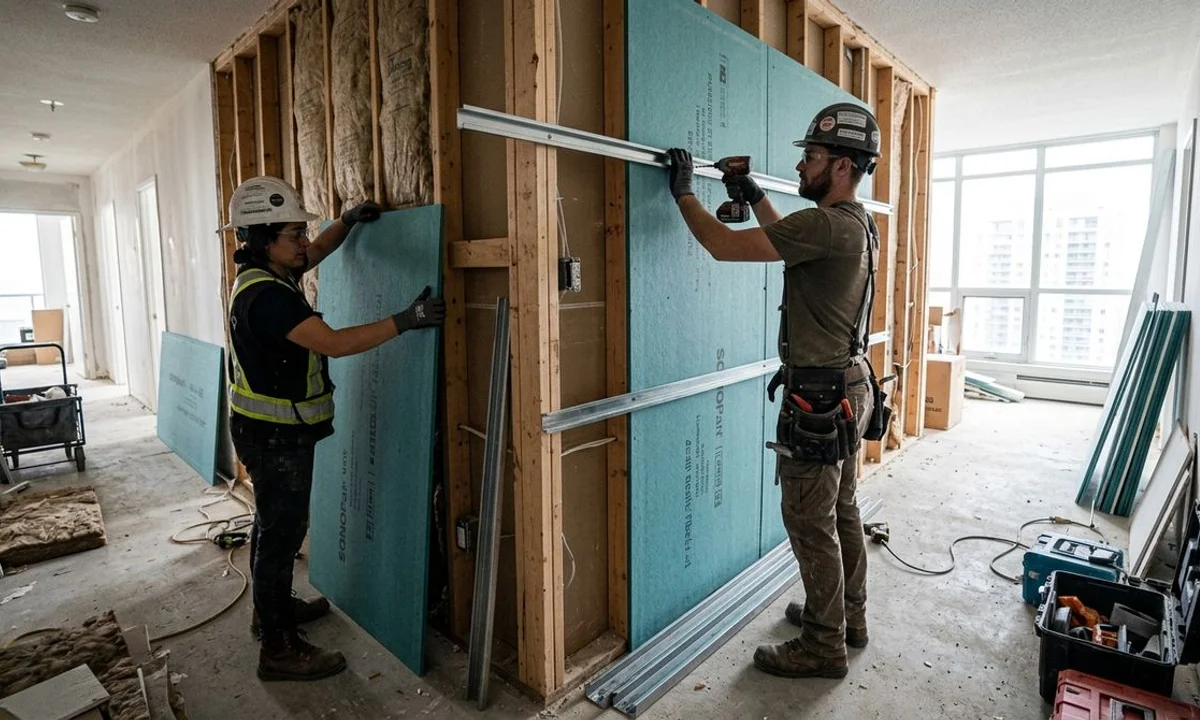
Resilient Channel (RC-1). Decoupling channel that mounts drywall away from the studs, breaking the direct sound path through framing. Adds significant STC improvement (often 10 plus points) but requires the wall to come down to studs.
Sound Attenuation Batts (SAB). Mineral wool batts inside the wall cavity. Modest STC improvement on their own (3 to 5 points), but they’re the cheap insurance every assembly should include.
Decoupled stud walls. Two separate stud walls with a gap between them, no rigid connection. Studio-grade STC, but requires more wall thickness than most condos can afford.
Retrofit vs Full Tear-Out
Most Toronto condo soundproofing jobs are retrofit work, adding mass and decoupling on top of an existing wall rather than tearing back to studs. Retrofit pros: cheaper, faster, less condo-board friction, fewer permit issues. Retrofit con: you can’t add resilient channel without coming down to studs, so the STC ceiling is around STC 60.
Full tear-out is the right call when:
- Existing wall is already failing (cracks, deteriorating drywall, water damage history)
- Target STC is above 60
- The condo board has approved a full demo (rare but possible)
Condo Board Approval
Most Toronto condo boards approve interior wall acoustic upgrades, especially when there’s a documented noise complaint from a neighbor. We coordinate on:
- Work permit (board-level approval before mobilization)
- Building rules (elevator booking, parking, noise windows, dust containment)
- Assembly documentation (board often wants the spec for record)
We’ve completed acoustic retrofits in downtown Toronto towers, Etobicoke Humber Bay buildings, North York Yonge-corridor condos, and Mississauga Hurontario condos.
Where We Install Acoustic Drywall
Across the Greater Toronto Area with condo retrofit volume concentrated in downtown Toronto, Etobicoke, North York, and Mississauga.
What Is Acoustic Drywall?
Acoustic drywall is a sound-dampening wall or ceiling system that uses mass-loaded gypsum panels, resilient mounting channels, and acoustic sealant to reduce airborne noise transmission between spaces. It differs from standard drywall in that it is engineered to achieve a measurable Sound Transmission Class (STC) rating, which describes how well the assembly blocks sound. STC 50 is the Ontario Building Code minimum between dwelling units. STC 55 to 65 is what most homeowners actually need to eliminate noticeable noise from neighbours, home studios, or mechanical rooms. The system works by adding mass, decoupling the surface from the framing, and sealing every penetration against sound flanking.
What Does Acoustic Drywall Include?
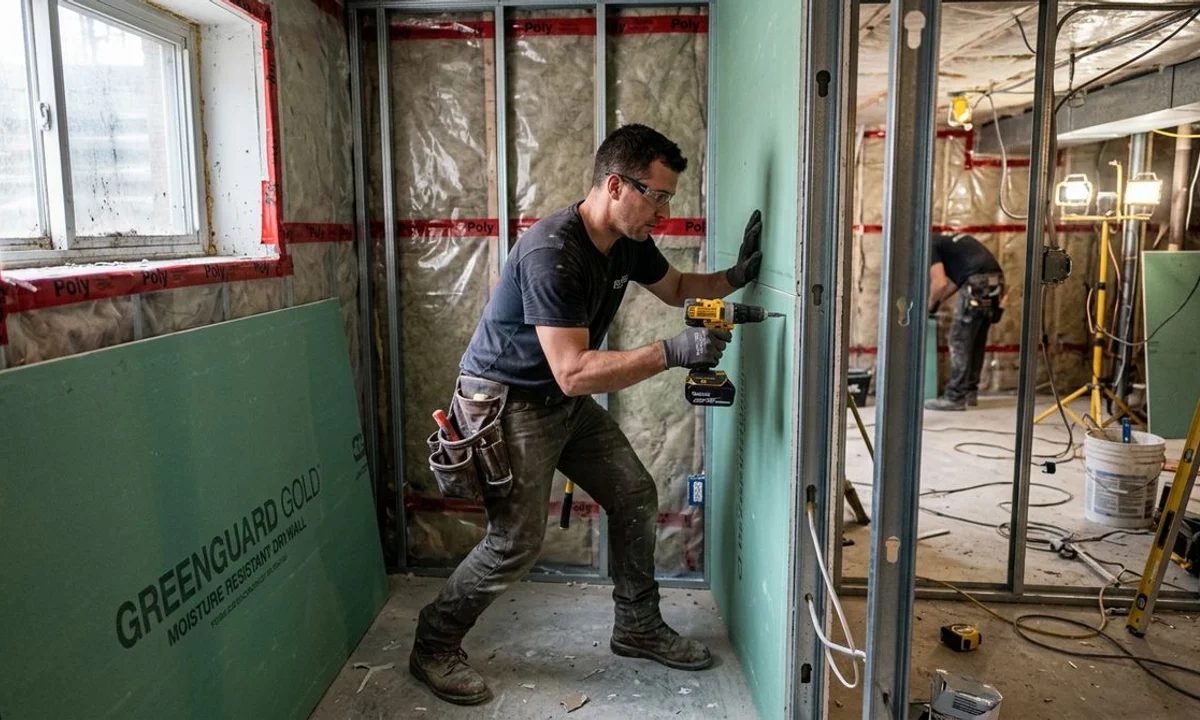
- Resilient Channel RC-1 or hat channel mounted to studs or joists before panel hang
- Staggered-stud or double-stud framing for higher-performance assemblies targeting STC 60+
- SONOpan acoustic wood-fibre panels or QuietRock constrained-layer gypsum in single or double-layer configuration
- Sound Attenuation Batts (SAB) in all wall and ceiling cavities
- Acoustic sealant at all perimeter gaps, outlet boxes, and penetrations to prevent flanking
- Standard tape, mud, and Level 4 finish over the completed assembly
How Much Does Acoustic Drywall Cost in Toronto?
Acoustic drywall in Toronto runs $5 to $12 per square foot installed depending on the STC target and assembly type. A retrofit-over-existing upgrade with SONOpan plus new drywall runs $5 to $8 per square foot. A full tear-out and rebuild with Resilient Channel and QuietRock runs $8 to $12 per square foot. Home studio builds with double-stud framing run higher. Free on-site estimate with STC recommendation included.
Who Needs Acoustic Drywall Installation?
Condo owners dealing with impact noise from upstairs neighbours in Toronto high-rises. Homeowners finishing a basement suite who need sound separation between floors. Music producers and content creators who need a quiet home studio. Commercial tenants fitting out offices where speech privacy between rooms is required.